When a system technically works, but nobody fully understands it anymore, what exactly broke?
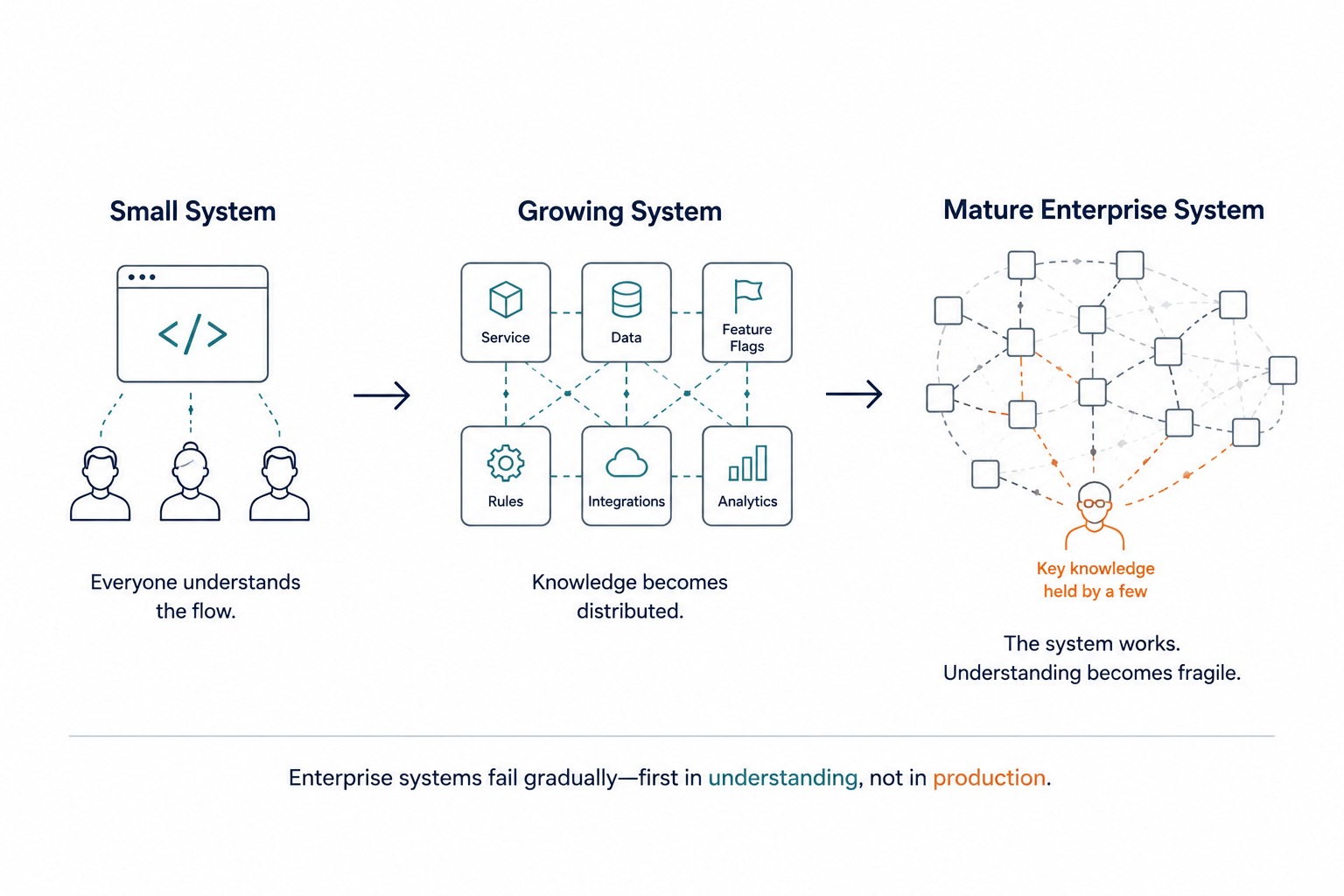
Every large enterprise system eventually develops a handful of people who "just know how things work."
Most enterprise systems are not difficult because they were poorly engineered. They become difficult because the system evolves faster than the organization's ability to preserve understanding.
A codebase that once felt manageable slowly turns into something teams hesitate to touch. New developers require weeks or months before they can contribute confidently. Senior engineers become knowledge bottlenecks. Architectural diagrams drift away from implementation reality. Documentation becomes stale. Even AI coding tools generate syntactically correct suggestions while missing critical business behavior.
Eventually, the system continues working, but understanding how it works becomes increasingly fragmented.
The ideas in this series are grounded in brownfield enterprise realities:
- Large monoliths
- Multiple teams
- Evolving architectures
- Inconsistent documentation
- Legacy behavior mixed with modern implementations
The goal is not to create a perfect system of truth. The goal is to continuously reconstruct business understanding directly from the codebase as the system evolves.
But first, let's understand why system understanding becomes one of the biggest scaling bottlenecks in enterprise engineering.
The Hidden Cost of Lost System Understanding
Most organizations recognize technical debt. Far fewer recognize "understanding debt".
Because, unlike infrastructure failures or production outages, the loss of system understanding rarely appears as a single visible event. It accumulates quietly.
Delivery slows down. Onboarding takes months. Cross-team changes require too many discussions. Production issues repeatedly get routed to the same engineers because "they know how this flow works."
Over time, organizations start adapting around the problem without explicitly acknowledging it. Knowledge starts to concentrate around people rather than systems. And most of this happens even when the system is technically functioning well.
Take something like a pricing workflow. It no longer lives in one service. It gets distributed across:
- Frontend validations
- Backend orchestration
- Feature flags
- Customer-specific rules
- Retry logic
None of these decisions seem dangerous individually. But collectively, they distribute business behavior across hundreds of implementation decisions. At that point, understanding a feature is no longer about reading an API controller or opening a UI screen. It becomes an exercise in behavioral reconstruction.
And this is where enterprise systems become expensive to change.
Not because engineers are incapable. But because understanding no longer scales with the system.
You might think we can simply write documentation for every feature and behavior whenever we add something to the codebase. Most organizations have already tried that approach. Eventually, the system evolves faster than the documentation process itself.
And that's where traditional documentation starts breaking down.
Why Traditional Documentation Continuously Fails
Most enterprise documentation fails for a simple reason:
The system evolves continuously, but the documentation process does not.
Documentation is usually treated as a parallel activity to engineering work. That model breaks down quickly in large systems.
A flowchart created three months ago may already be missing:
- New validations
- Retry behavior
- Feature flags
- Integration changes
- Orchestration rules
The problem is not that teams do not care about documentation. The problem is that maintaining behavioral understanding manually at enterprise scale is extremely difficult, especially when multiple teams contribute simultaneously, release velocity increases, and legacy and modern patterns coexist.
As a result, documentation becomes stale and untrusted. Teams adapt around the problem. Senior engineers become walking knowledge indexes.
New developers learn to "ask the right person." Eventually, developers trust implementation more than documentation.
The impact extends beyond engineering teams. As systems evolve, stakeholders gradually lose visibility into whether implemented behavior still matches business intent. Requirements may exist. Code certainly exists. But answering a simple question like "Is the system still behaving the way the business intended?" becomes surprisingly difficult.
This creates another challenge: implementation is optimized for execution rather than understanding.
And this becomes even more important as organizations adopt AI-assisted engineering workflows, because AI systems inherit the same understanding gaps that engineering teams already struggle with.
But wait, can LLMs understand an enterprise system if we simply give them access to the repository?
Why AI Still Struggles With Enterprise Systems
Modern LLMs are already very good at understanding code.
The challenge is not code comprehension. The challenge is context reconstruction. In large enterprise systems, every question forces the model to rebuild understanding from raw implementation. That leads to higher token consumption, slower reasoning, and inconsistent results. The problem is not that knowledge is missing. The knowledge already exists inside the codebase. The problem is that it remains fragmented across implementation details.
And that changes the problem entirely.
Instead of manually documenting behavior, system understanding can be continuously reconstructed from the implementation itself. Once that context becomes continuously available, documentation stops being the final output. It becomes infrastructure. Infrastructure for onboarding, impact analysis, AI-assisted engineering workflows, RAG systems, and engineering copilots. In many ways, documentation becomes a shared knowledge layer for both humans and AI systems.
Toward Living System Understanding
Most teams treat documentation as a separate activity from engineering.
But enterprise systems already contain most of the knowledge organizations are trying to preserve. The challenge is continuously extracting, organizing, and regenerating that understanding as the system evolves.
A simplified view looks like this:
Code → Behavior Reconstruction → Business Understanding → Documentation → AI Context
When reconstruction becomes continuous, documentation stops being the destination. It becomes a by-product of system understanding.
The challenge is no longer storing knowledge. The challenge is keeping it synchronized with reality as systems evolve.
Which raises an important engineering question:
If the knowledge already exists inside the system, can we continuously reconstruct that understanding directly from the codebase itself?
What Comes Next in This Series
In the next article, we'll pick a real functional area inside a brownfield system and use AI-assisted reverse engineering to reconstruct how it actually behaves.
No architecture redesign. No knowledge graph. Just a real codebase, an AI agent, and a repeatable reconstruction process.
If enterprise systems become difficult because understanding stops scaling, can we generate that understanding directly from the implementation itself?
We'll test that idea and see what kind of business understanding can actually be reconstructed from implementation alone.



 When to Hire CodeWalnut?


